
Checking Criminal History in Richland County
A reliable Richland County criminal records search begins with the South Carolina Judicial Branch county selector. Choose Richland County, then use a complete case number when one is known. A name search can work, but spelling variants and common names demand more care. Compare the court agency, filing date, charge, and case status before deciding that a result belongs to the right person. The Public Index needs cookies and JavaScript, and some case details open in a new browser window. A desktop browser with pop-ups allowed is often the soundest choice.
The first source should match the question. The county jail answers whether someone is now detained. A police report gives an officer's account of an incident. A court file shows what prosecutors filed and how the case ended. SLED supplies the statewide criminal-history layer. Use this order for a well-supported Richland County check:
- Search the South Carolina Judicial Branch Case Records Search, select Richland County, and verify the court agency.
- Read the docket from oldest to newest. Note the filed charge, bond events, hearings, and final disposition rather than relying on the arrest label.
- Ask the fourth-floor General Sessions Criminal Records office for any warrant, indictment, sentence sheet, or bond paper that is not imaged online.
- Check current custody through the Alvin S. Glenn detainee lookup, or switch to SCDC when the person has entered state prison.
- Use SLED CATCH for a statewide South Carolina name check, then request a focused police or county record when an online source leaves a gap.
Why Richland Criminal Searches Differ
One Richland County event can produce several records that are not interchangeable. The arresting officer creates an incident or arrest report. Alvin S. Glenn staff make a booking record after intake. Bond Court records the first release decision. The court clerk tracks the filed prosecution. SLED receives reportable fingerprint-supported arrest data and later dispositions. Each source answers a different question and may update on a different schedule.
The path is: Incident or arrest report → jail booking → bond decision → filed court case → disposition reported to SLED. A charge can be amended, dismissed, or replaced along that route. Therefore, a jail allegation should never be read as a conviction, and a blank jail search does not erase a court case. A recent event may not yet have reached the state repository. Richland County records are clearest when the reader compares the source closest to the event with the source that holds the final outcome.
Note: A no-result screen answers only the scope and date range of the system searched.
South Carolina Official Background Checks
The SLED Citizens Access to Criminal Histories, known as SLED CATCH, provides a public South Carolina name-based check. It uses the name and date of birth supplied by the requester. It is not an FBI fingerprint identity-history summary, and a name match does not guarantee positive identification. Similar names, incomplete birth data, and aliases can affect the result. A mailed SLED request is also available for people who do not want to use the online payment channel.
The official SLED CJIS office maintains the central state repository. For a personal federal identity-history review, the FBI process uses fingerprints rather than just a name. IdentoGO in South Carolina handles electronic fingerprint appointments for authorized programs, while some local agencies offer ink cards and set their own charges. The service code controls the purpose and destination of results, so it must come from the authorizing program.
The official SLED CATCH entry screen can be seen at its government source.
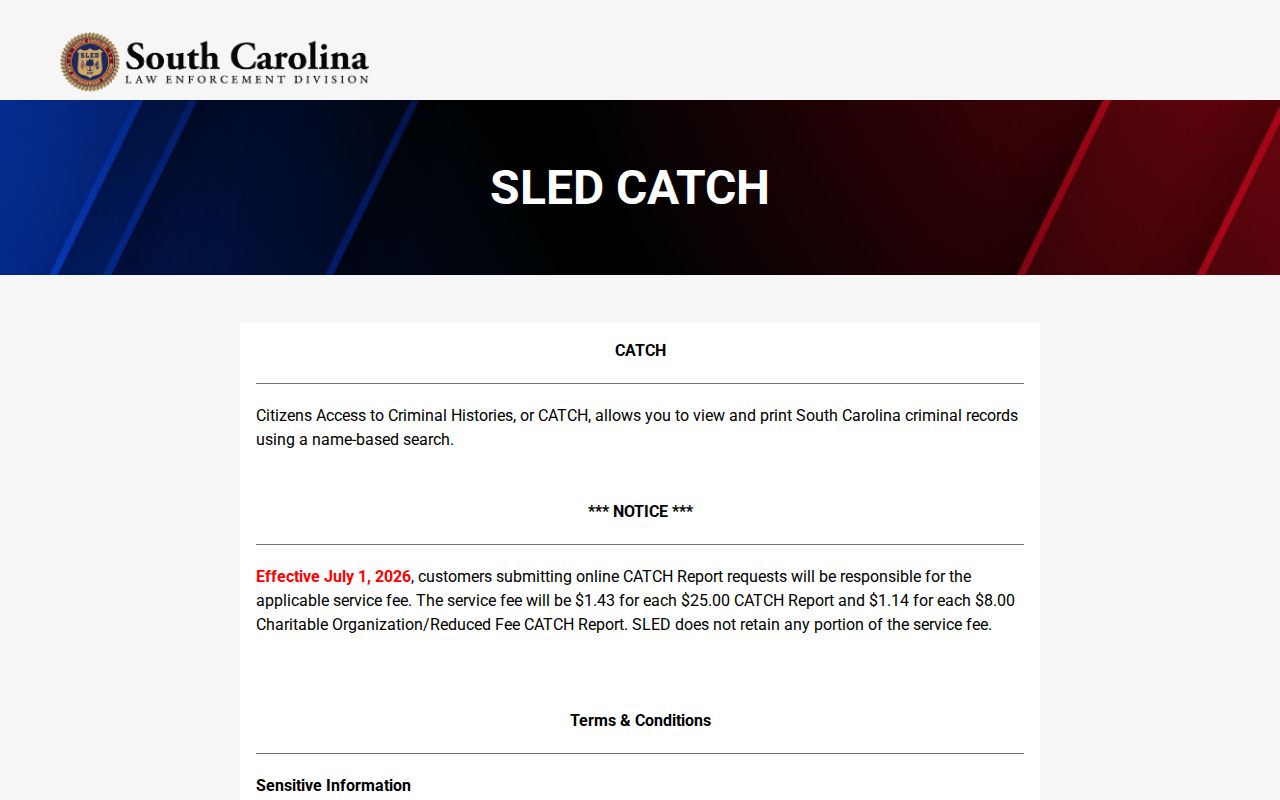
The image shows the state entry point that adds a statewide name-based layer to local Richland County court and agency research.
SLED CATCH Fields for Richland Records
SLED CATCH asks for enough identity data to run a name-based search, but the fields do not turn it into fingerprint identification. Use the legal spelling and exact date of birth when known. A middle name can narrow a common match. An alias or former surname may require a separate search. Sensitive data belongs only in the secure official portal, never in a message to an unrelated service.
| Field | Use | Status |
|---|---|---|
| Last name | Primary identity input | Required |
| First name | Primary identity input | Required |
| Middle name | Narrows similar names | Optional |
| Date of birth | Improves name matching | Required |
| Social Security number | Sensitive narrowing identifier when offered | Optional |
| Acknowledgement | Confirms portal terms | Required |
The posted base cost is $25. Beginning July 1, 2026, SLED lists a $1.43 online service fee on a $25 report and $1.14 on a reduced $8 report. A mailed request avoids the online service fee and requires SLED's form, a self-addressed stamped envelope, and accepted certified funds. The live portal controls current charges.
Criminal Record Types
Richland County criminal records are grouped by the office that makes them. That point matters because no clerk can certify records outside the clerk's custody. General Sessions expressly does not keep Magistrates or municipal charges and cannot issue a certified full background check. A Columbia, Irmo, or Forest Acres case may remain in a city court, while a lower-level county matter can sit with one of Richland County's Magistrates Courts.
- Incident and arrest reports: RCSD, a city police department, campus police, SLED, or another responding agency records the event and officer narrative.
- Booking and custody records: Alvin S. Glenn connects intake, identity, charges, bond, and present detention status.
- Court case files: General Sessions, Magistrates Courts, and municipal courts retain their own warrants, dockets, pleadings, and outcomes.
- State criminal history: SLED CJIS pairs qualifying arrest cycles with reported court dispositions.
- Supervision and registry records: SCDPPPS tracks probation and parole, while SLED maintains the state sex offender registry.
Warrant information is also split. A filed General Sessions warrant may appear in a case file. A summary bench warrant belongs with the issuing Magistrates Court, and a city bench warrant stays with that municipal court. RCSD has no verified public, comprehensive active-warrant name list.
Richland Sheriff Criminal Record Requests
The Richland County Sheriff's Department holds sheriff-created incident and arrest material at 5623 Two Notch Road, Columbia, SC 29223. Its Records Division can be reached through 803-576-3000. For certain routine report copies, including requests involving juvenile information or an involved person, RCSD directs the requester to appear with valid photo identification and $2 cash per report. Juvenile information is redacted. Records business hours are 8:00 a.m. to 4:15 p.m.
Broader requests go through the RCSD Public Affairs and FOIA office. A written request may be emailed to foiarequest@rcsd.net, mailed to headquarters, or delivered in person on weekdays from 8:30 a.m. to 4:30 p.m., excluding holidays. Give a date range, place, incident number, and exact document name. Narrow terms help the office locate the Richland County record and can reduce billed search or redaction time.
The department's public face is shown on the official RCSD website.
This agency channel is the right starting point for an RCSD report, while court pleadings remain with the proper clerk.
Inside a Richland County Criminal Record
The contents depend on the record type. A repository response is built around identity and arrest cycles. A court file is organized around a case number, pleadings, events, and outcome. A jail profile centers on booking and custody. The reader should not expect a bond amount from every SLED result or a full police narrative in a Public Index docket.
| Name and identifiers | Legal name, aliases, birth data, descriptive information, and state or FBI identifiers where the source lawfully displays them. |
|---|---|
| Arrest and booking | Arrest date, agency, booking identifier, intake time, initial charges, and current custody fields in the jail system. |
| Charges and statutes | Alleged offense names and codes, which may differ among arrest, indictment, and final disposition. |
| Court progress | Case number, filing date, judge, attorneys, bond actions, hearings, motions, and chronological docket entries. |
| Disposition and sentence | Dismissal, nolle prosequi, plea, acquittal, conviction, sentence, fines, restitution, or other recorded outcome. |
| Custody or supervision | County detention, state prison, probation, or parole details within the limits of the source searched. |
Public Index home-address display changed on January 1, 2026. New and existing public-index cases no longer show home addresses, though the underlying file may still contain material governed by court access rules. Protected victim data, Social Security numbers, juvenile information, sealed items, and other sensitive fields are not proper public-index content.
Richland Custody Records Change Systems
The Alvin S. Glenn detainee lookup covers people currently held at the county facility. Its starting form asks for first name, last name, and a CAPTCHA. It does not initially offer date of birth, booking number, booking date, or arresting agency. That makes a common-name match less certain. A blank result can mean release, transfer, a spelling difference, or booking in another county rather than no arrest.
Once a sentenced person enters state prison, change systems. The SCDC Incarcerated Inmate Search covers the state correctional population, not ordinary county pretrial detention. VINELink can supplement the two with custody and release notification, but it is not the underlying jail or prison record. Questions about the county lookup go to Alvin S. Glenn at 201 John Mark Dial Drive, Columbia, SC 29209, 803-576-3200.
The state locator interface is available from the official SCDC search source.
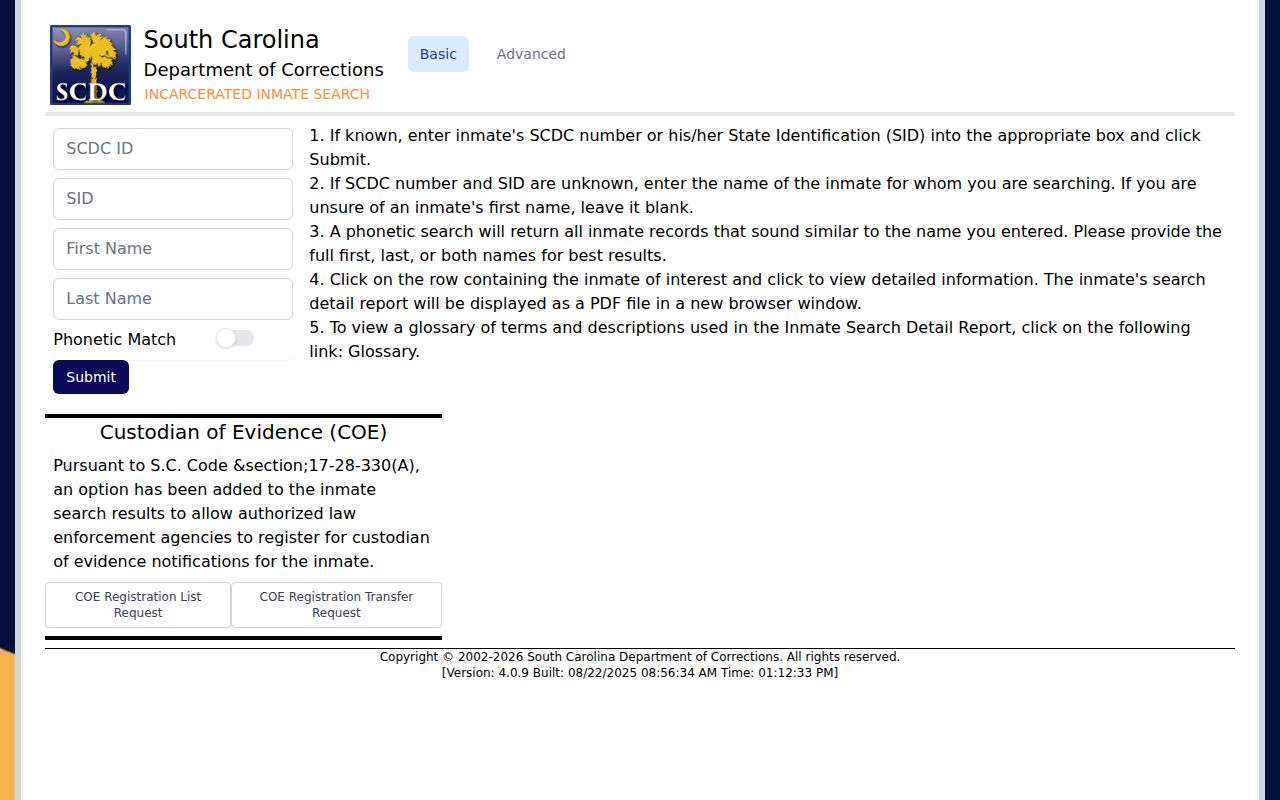
The screen marks the point where a Richland County custody search moves from the county jail to the state prison system.
Public Access Laws in South Carolina
The South Carolina Freedom of Information Act creates a route to inspect or copy non-exempt public records, but it does not make all criminal material open. Active investigations, juvenile files, victim-sensitive facts, protected identifiers, and records made confidential by another law may be withheld or redacted. An agency may segregate releasable parts and charge reasonable actual costs for search, retrieval, redaction, and copying.
Key South Carolina laws:
S.C. Code § 30-4-10 et seq. gives access to non-exempt public records and sets response and fee rules.
S.C. Code § 30-2-50 bars use of government-held personal information for commercial solicitation.
S.C. Code § 23-3-110 et seq. establishes SLED's criminal-identification and repository duties.
S.C. Code § 17-1-40 provides record destruction for qualifying dismissed, discharged, and not-guilty outcomes, subject to its terms.
Richland County's general FOIA channel applies to county departments, including detention material not routinely posted. Sheriff records go to RCSD, and judicial records follow court access rules. Sending the same broad request to all three does not improve accuracy. Direct each request to the office that created or keeps the item.
Richland Criminal Records Request Costs
Costs change with the office and the work needed. RCSD posts one set of charges, while Richland County posts another. Under section 30-4-30, an agency may require a deposit of up to 25 percent of expected reproduction costs. Ask for an estimate and narrow an oversized request before authorizing work.
| Product or work | Posted charge |
|---|---|
| Routine RCSD report copy | $2 cash per report |
| RCSD retrieval or redaction | $37 per hour |
| RCSD archive retrieval | $36 per box |
| RCSD printed page | $0.15 per page |
| County hard copy | $0.25 per page |
| County off-site retrieval | $25 per retrieval |
Both RCSD and the county list $5 optical media charges. County labor uses the prorated gross hourly rate of the lowest-paid qualified employee. The Richland County public-records channel is the official place to review county policy. A clerk copy or certification may carry a separate court charge, so request a quote before ordering a large General Sessions file.
Sealed, Expunged, and Restricted Records
South Carolina expungement depends on the offense and outcome. Section 17-1-40 addresses qualifying charges that are discharged, dismissed, or end in a not-guilty finding, but it has conditions and exceptions. Other statutes apply to certain diversion programs and eligible convictions. Eligibility alone does not hide a Richland County record. A signed order must be processed by each record-holding agency.
For a General Sessions matter, begin with the Fifth Judicial Circuit Solicitor. The office reviews eligibility, collects required payments, circulates the proposed order, and presents it for judicial signature. Dismissed, nol-prossed, or not-guilty matters are free unless the dismissal was part of a plea negotiation. Other eligible cases may require separate $25 SLED, $35 clerk, and $250 solicitor payments in certified funds. Summary or municipal matters may begin with the court or solicitor route tied to that result.
A pardon is distinct from expungement and does not by itself erase the public arrest and court trail. Juvenile records follow special confidentiality and Family Court rules. Sealed warrants, protected investigations, victim information, and detailed supervision notes can also remain outside ordinary public access. Keep certified copies of any order, allow time for agency processing, and recheck both the court index and a personal SLED record.
Richland Criminal Warrant Fallback
Richland County has no verified public RCSD active-warrant name portal or complete public list. The detainee lookup is not a warrant search. Start with the correct court instead. A filed General Sessions case may show warrant-related docket activity, and the fourth-floor clerk can supply releasable filed warrants or bond papers. Summary bench matters belong with the issuing Magistrates Court. Municipal bench warrants remain with the city court.
If the court is not known, call RCSD at 803-576-3000 with the name and any case, warrant, date, or incident details. The Warrant Division and Fugitive Team operate from the Decker Center, but no direct public warrant line was verified. Ask the issuing court to confirm the number, alleged charge, active or withdrawn status, bond, and appearance instructions. Do not assume that a web absence or online citation payment resolves a warrant.
- Arrest warrant
- A judge's command authorizing arrest on stated probable cause.
- Bench warrant
- A court warrant often issued after failure to appear or obey an order.
- Search warrant
- Authority to search a place or item, which may be sealed before execution.
- Capias
- A court writ directing that a person be taken into custody.
Richland Probation and Parole Records
South Carolina runs probation and parole through the Department of Probation, Parole and Pardon Services. The Richland County office is at 300 Columbia Mall Boulevard, Suite 110, Columbia, SC 29223, with telephone 803-734-6320. Probation is a court sentence served under community supervision. Parole is conditional community release from prison under state authority. A court docket may show the sentence or a revocation filing, while detailed supervision notes remain restricted.
The SCDPPPS offender search accepts combinations of first name, last name, birth year, county, or SID number. It reflects the prior day's information, so county staff are the source for a current-day question. A person who has completed supervision may no longer appear. SCDC should be checked only when prison custody is relevant.
The statewide supervision authority describes its work on the official SCDPPPS portal.
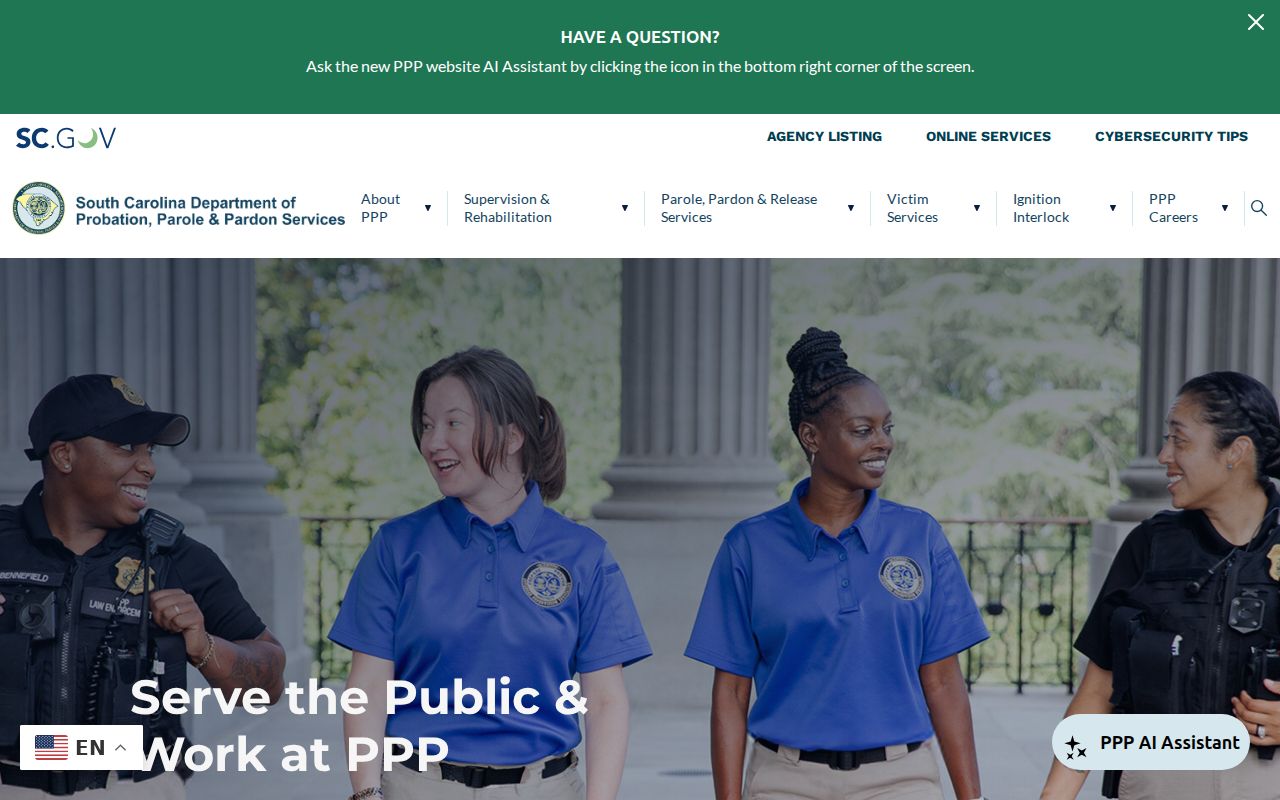
The portal adds the probation and parole layer that a Richland County court docket or jail search cannot fully answer.
Richland County Criminal Records by City
City police departments create their own reports, and municipal courts keep city criminal, traffic, and ordinance dockets. Columbia and Irmo cross the Lexington County line, so the place name alone does not identify the correct jail or court. Forest Acres uses Columbia mailing addresses even though its police and court are separate. These Richland County city records pages focus on the local route that comes before a county or state search.
Columbia Criminal Records
Population 147,035 · CPD reports and Columbia Municipal Court records require county-side routing.
Irmo Criminal Records
Population 12,204 · Irmo police and court records may connect to either Richland or Lexington County.
Forest Acres Criminal Records
Population 10,390 · Forest Acres Police and Municipal Court share the North Trenholm Road site.