
Richland County Criminal Court Cases
South Carolina Circuit Court, Court of General Sessions, hears Richland County felony and other higher criminal matters. Its Criminal Records unit is on the fourth floor of the Richland County Judicial Center. The clerk holds filed warrants, indictments, sentence sheets, bond papers, pleadings, and related case documents. General Sessions is only one layer. Richland County Magistrates Courts issue warrants, conduct preliminary hearings, and hear criminal and traffic matters assigned by statute. Municipal courts keep city ordinance and other lower-level cases within their own jurisdiction.
This split matters when a name is absent from one index. The General Sessions clerk expressly does not maintain every Magistrates or Summary Court charge and cannot issue a certified full criminal background check. Some municipal courts contribute records to Public Index, while others may require direct contact. Searchers should first identify the court agency on a ticket, warrant, bond sheet, or prior docket. The court agency, not just the Richland County address, determines where the complete case file resides.
Richland Public Index Search
The official Richland County Public Index is the main remote entry point for a local criminal case search. The South Carolina Judicial Branch advises users to enable cookies and JavaScript and allow a pop-up window for case detail. A desktop browser may handle the legacy windows more reliably than a phone. Case number is the strongest key. When searching by name, compare the court agency, filing date, case type, and charge before deciding that a result concerns the intended person.
The captured interface from the official Richland County Public Index shows how local court records are reached through the judicial system.
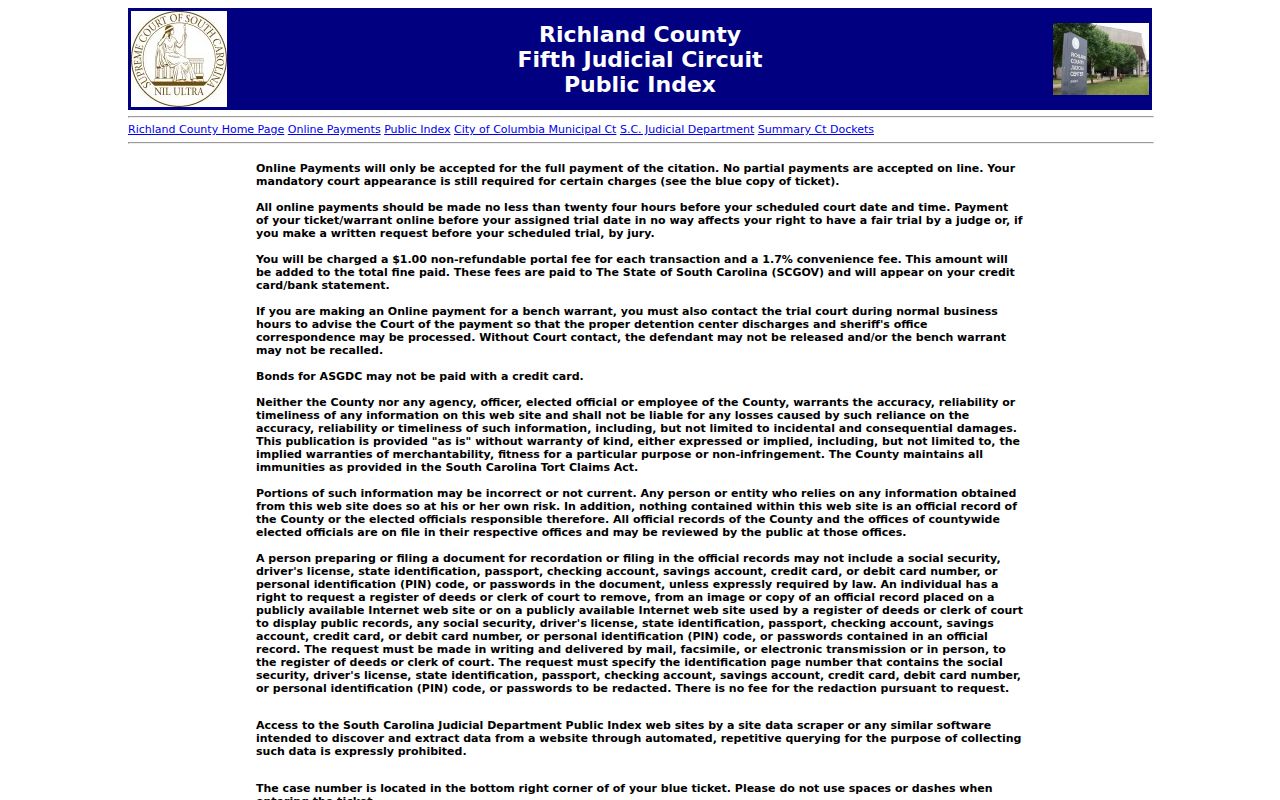
That screen is the docket doorway. It may provide event data without a free image of every pleading, warrant, indictment, or sentence sheet.
Searching Richland County Case Records
A careful Richland County case search moves from broad identification to a focused file request. Read entries in date order because the arrest allegation, indictment, and final disposed charge may differ. Never treat a common-name result as a match based on the name alone.
- Open the Judicial Branch case-record search, select Richland County, and allow the case-detail pop-up.
- Use the full case number when known. Otherwise enter the surname and given name, then compare likely results.
- Confirm the court agency, filing period, case type, and charge before opening the docket.
- Read bond events, hearings, pleadings, charge entries, and disposition from oldest to newest.
- Request any needed paper or certified document from the clerk that actually holds the Richland County file.
| Field label | Type | Required | Use |
|---|---|---|---|
| Search type | Tabs/options | One method | Choose party name, case number, or another offered method |
| Last Name | Text | For name search | Try legal surname and supported spelling variants |
| First Name | Text | Not stated | Narrows common surnames |
| Middle Name | Text | No | Can over-narrow when the court record omits it |
| Case Number | Text | For case search | Use the complete court identifier |
| Court Agency | Dropdown | No | Limits results to the selected court |
| Case Type / Date | Dropdown/date | No | Narrows the matter and filing period |
Which Richland Court Holds It
Felony and serious criminal case papers go to General Sessions at 1701 Main Street. Bond Court operates at Alvin S. Glenn Detention Center and handles initial bond matters around the clock. Central Court at 2500 Decker Boulevard performs Summary Court functions. Richland County also has Magistrates Courts serving Columbia, Blythewood, Dutch Fork, Eastover, Hopkins, Lykesland, Olympia, Pontiac, Upper Township, Waverly, and Dentsville areas. The issuing location on a citation or warrant is often the best clue.
If a lower-court record does not appear in the Richland County General Sessions view, call the named Magistrates Court rather than repeating the same search. City matters must be checked under the participating municipal agency or with that municipal clerk. This is especially important near municipal boundaries. A mailing address alone does not prove which police agency or court handled the event.
Note: General Sessions, Summary Court, and municipal files are separate record systems even when one event began in Richland County.
Inside a Richland County Case File
A court file follows the prosecution, not merely the arrest. It can show the accusation presented to the court, later charging action, hearings, motions, disposition, and sentence. The online docket may expose metadata while the underlying paper remains with the Richland County clerk. Starting January 1, 2026, public-index home addresses are no longer displayed. Protected victim data, sensitive personal identifiers, sealed material, and juvenile records also remain outside ordinary public view.
| Case number and court | The unique proceeding identifier and the agency that owns the file |
|---|---|
| Charging document | Warrant, indictment, complaint, or other filed accusation as applicable |
| Docket entries | A dated sequence of filings, hearings, orders, and court events |
| Bond actions | Filed conditions, changes, and related bond papers |
| Disposition | The recorded outcome for a charge or case and its date |
| Sentence | The court-ordered consequence after a conviction |
Reading Richland Docket Terms
Short docket terms can change the meaning of a Richland County result. A charge is an allegation. An indictment is the grand jury's formal accusation and is not a conviction. The final docket entry must be read for each charge because one count may be dismissed while another ends in a plea or trial judgment.
- True bill
- The grand jury returned an indictment on the submitted accusation.
- No bill
- The grand jury declined to indict on that submitted accusation.
- Nolle prosequi
- The Solicitor formally chose not to continue a charge at that time.
- Disposition
- The recorded outcome, such as dismissal, acquittal, plea, or conviction.
- Pending
- The Richland County matter has not reached a final recorded outcome.
These terms explain status, not the full reason behind the outcome. For that, ask for the relevant order, plea document, verdict form, or sentence sheet.
How a Criminal Case Moves
A Richland County case may begin with a warrant and arrest, but the court record develops in stages. Bond Court sets initial release conditions. A magistrate may hold a preliminary hearing. The Fifth Judicial Circuit Solicitor evaluates a General Sessions prosecution, and a grand jury may act on an indictment. The clerk then records court filings, hearings, motions, and the result. Not every case passes through every event, and a negotiated plea may end the case before trial.
Case flow: Charges Filed › Arraignment › Pretrial › Plea or Trial › Disposition › Sentencing
After checking the Richland County arrest record, use the criminal court file to verify the final charge and judgment. Appeals and later orders can add more docket events, so note the date of the last entry reviewed.
Requesting Richland Filed Papers
When Public Index lacks the document itself, contact the General Sessions Criminal Records unit. Visit the fourth floor at 1701 Main Street, Columbia, SC 29201, or mail a focused request to P.O. Box 2766, Columbia, SC 29202. The criminal desk's main number is 803-576-1950. Give the complete case number, court, party name, and exact documents wanted. Ask for a written quote before ordering a large or certified file because the clerk page does not publish a full copy tariff.
General Sessions Criminal Records
Richland County Judicial Center
1701 Main Street, 4th Floor
Columbia, SC 29201
803-576-1950
Mail: P.O. Box 2766, Columbia, SC 29202
Do not use the General Sessions litigation-filing email as a general public-record inbox. For a Magistrates or municipal matter, direct the request to the court named on the case.
Richland Charges and the Solicitor
The Fifth Judicial Circuit Solicitor prosecutes General Sessions matters in Richland and Kershaw Counties. Its decisions help explain why the filed indictment or disposition can differ from an officer's first arrest charge. The office also operates diversion and treatment-court channels, including DUI Treatment Court and Mental Health Treatment Court. A Richland Mental Health Court referral packet can include the warrant, rap sheet, incident report, victim-impact statement, and restitution information, but program participation and later expungement are separate legal steps.
The official Fifth Judicial Circuit Solicitor site identifies the local prosecuting office and its services.
This prosecutorial source adds context to the clerk's neutral docket, but the filed court record remains the source for the official case history and outcome.
Case Record Access and Restrictions
South Carolina's Freedom of Information Act provides access to non-exempt public records, but court access also reflects rules that protect sealed files, juvenile matters, victims, and sensitive identifiers. An online omission may mean the case belongs to another court, a document was never imaged, or access is legally restricted. It does not, by itself, establish that no Richland County record exists.
When a case cannot be found, verify spelling and the court first. Then ask the proper clerk whether an older, archived, sealed, or non-indexed file exists and what proof of identity or party status is required. Eligible dismissal, not-guilty, and nolle-prosequi outcomes may qualify for record destruction under S.C. Code §17-1-40, subject to its conditions. Eligibility alone does not hide a case before a valid order is completed and processed by each record holder.
For an older or non-imaged Richland County filing, give the clerk the full case number and exact paper needed. That detail separates a docket question from a request for the underlying warrant, indictment, bond paper, or sentence sheet.