
Checking Criminal History in Columbia
Start a Columbia criminal records search by identifying the agency and county of occurrence. The Columbia Police Department holds its own incident and arrest reports. Columbia Municipal Court keeps city criminal, traffic, and ordinance matters. A felony filed in Richland County moves to General Sessions, while a current Richland-side booking is held by Alvin S. Glenn Detention Center. The address printed on a report, citation, or bond paper is more useful than a broad city-name search.
- Confirm whether CPD, RCSD, campus police, or another agency responded, and note the incident or report number.
- Request the officer narrative through the official Columbia Police FOIA channel, using the date, location, names, and report number.
- Search Columbia Municipal Court by selecting the city court in the Public Index Court Agency field.
- For a Richland-side booking or higher criminal case, use Alvin S. Glenn and the Richland County court channels.
- Add SLED CATCH only when a statewide South Carolina name-based criminal-history layer is needed.
This order keeps the city facts tied to their source. A Columbia arrest allegation can change before the filed charge or disposition, so the report, booking, and court result should be read as separate records.
Columbia Criminal Records Cross Counties
Columbia occupies land in both Richland and Lexington counties. That boundary controls where an arrest enters bond court and which county jail holds the booking. CPD arrests on the Richland side go to Alvin S. Glenn, where bond sessions are held at 9 a.m. and 2 p.m. Lexington-side arrests follow the city's Washington Street routing at different sessions. A citywide name search can blur that split.
When the county is uncertain, inspect the incident location, jail name, court agency, and case number before placing a records request. The city population estimate of 147,035 covers the whole place, not only its Richland County side. For the same reason, a Columbia street address does not prove CPD responded. Unincorporated areas may fall under RCSD, while Forest Acres uses Columbia mailing addresses but has its own police department and court.
Note: The city name identifies a place, but the incident location identifies the proper criminal-record route.
Columbia Police Department Records
CPD headquarters is at 1 Justice Square, Columbia, SC 29201. The nonemergency number is 803-545-3500. CPD creates the first city record when its officers investigate an incident or make an arrest. That agency file may contain the narrative, location, people involved, officer actions, property, initial allegations, and report number. It does not establish the later court outcome.
The city's FOIA form asks for the requester's name, street address, email, daytime phone, signature, and date. A detailed record description should include dates, locations, names, and the relevant report identifier. Those facts keep the request tied to one event and reduce delay. Active investigative facts, juvenile material, protected victim information, and personal identifiers can be withheld or redacted under law.
Columbia Police maintains an official agency site where readers can identify the department before submitting a request.
The department's public presence is pictured at the official Columbia Police source.
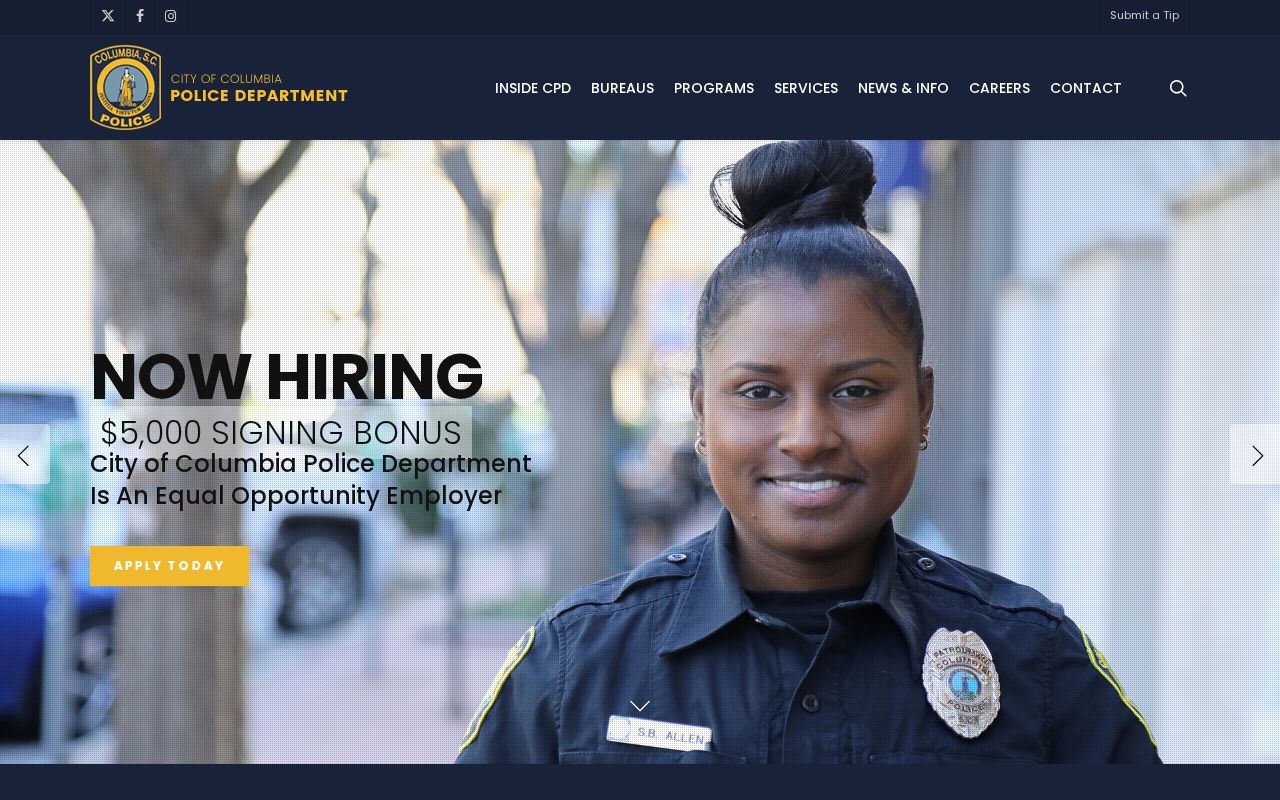
The image connects Columbia police records to the city agency that created them, rather than to a county or private database.
Columbia Police Record Request Details
A focused CPD request names the exact document sought. Ask for an incident report or arrest report rather than an undefined criminal history. Include the event date, street or location, report number, and known names. If a city record later led to a jail booking, request the booking from the county custodian rather than expecting the CPD narrative to contain the complete detention file.
City staff may route a broad criminal-record question among CPD, RCSD, and SLED because those offices hold different products. CPD is the source for its officer-created material. RCSD holds sheriff reports. SLED supplies the statewide name-based response. A Columbia requester who knows which product is needed will reach the correct office sooner and avoid paying for a search that cannot answer the question.
- Incident report
- The responding agency's account of the reported event and investigative steps.
- Arrest report
- The agency record of the arrest basis, initial allegation, and officer action.
- Booking record
- The jail's separate intake, charge, bond, and custody entry.
- Disposition
- The court's recorded outcome for a charge or case.
Columbia Arrests and Bookings
For a Richland-side CPD arrest, city officers create the police record and Alvin S. Glenn creates the booking after transport. Jail staff establish identity, take fingerprints and a photograph, link the initial charges and warrants, inventory property, complete screening, and route the person to Bond Court. Those acts generate custody data that is separate from the officer narrative.
The Alvin S. Glenn current-detainee lookup starts with first name, last name, and a CAPTCHA. It does not offer a date-of-birth or booking-number filter on the first form. No result can mean the person bonded out, was released, transferred, was booked on the Lexington side, or appears under another spelling. Historical booking records require the county route because the public search is described as a current-detainee system.
A Columbia arrest is not a conviction. The initial charge can change when a prosecutor reviews the case, a grand jury acts, or the court enters a final result. The county-wide arrest page explains that distinction in more depth through the Richland County arrest lookup.
Columbia Criminal Bond Routing
Bond is the first major routing clue after a Columbia arrest. Richland-side CPD bookings use the Bond Court at Alvin S. Glenn. That court operates around the clock, while the stated CPD bond sessions occur at 9 a.m. and 2 p.m. A bond record sets release terms in the pending case. It does not decide guilt and does not replace the Municipal Court or General Sessions docket.
The Columbia Municipal Court has a direct fine and bond line at 803-545-3140. Its arrest and bench-warrant line is 803-545-3166. Those numbers serve city court matters. A higher Richland County prosecution belongs with the clerk at the Judicial Center, while a Lexington-side matter must be routed there. Ask for the case number, court name, charge, and next appearance instructions before relying on a payment screen or an old notice.
Municipal Court Records in Columbia
Columbia Municipal Court is at 811 Washington Street and can be reached at 803-545-3150. It is open weekdays from 7:30 a.m. to 5 p.m. The court hears city criminal, traffic, and ordinance matters. Richland County maintains Columbia Municipal Court records from 1988 onward, and the official lookup instructions tell searchers to select Columbia Municipal Court in the Public Index Court Agency dropdown.
| Court name | Columbia Municipal Court |
|---|---|
| Case types | City criminal, traffic, and ordinance matters within municipal jurisdiction |
| Lookup channel | South Carolina Public Index with Columbia Municipal Court selected as the Court Agency |
| Docket contents | Case number, charge, filing and event dates, status, court events, and disposition where entered |
| Clerk access | Counter and telephone help for procedure, calendars, copies, warrants, fines, and bonds |
Exact identifiers help. Columbia's Motion to Reopen form asks for the county, case number, defendant, charges, contact details, trial date and time, judge, officer or agency, stated reasons, signature, and date. That list shows why a name alone may not be enough to retrieve the right city file.
Columbia Criminal Court Calendar
The city calendar reflects Columbia's own court workload. Weekly sessions include criminal and jury matters on Monday, traffic and jury matters on Tuesday, criminal, Domestic Violence, and Quality of Life courts on Wednesday, and traffic and jury matters on Thursday. A calendar places a case on a session, but the docket remains the source for its filed events and outcome.
Direct court lines can reduce misrouting. Regular criminal and traffic questions go to 803-545-3127, jury questions to 803-545-3169, fines and bonds to 803-545-3140, and arrest or bench-warrant questions to 803-545-3166. Court staff can explain process and access, but they cannot supply legal advice. Confirm the current calendar and appearance terms with the court before acting on an old notice.
Where Columbia Records Go
A CPD case stays local at first. The police report remains with the city. A Richland-side booking creates a separate county jail entry. Municipal charges remain with Columbia Municipal Court, while felonies and higher criminal matters move through the Richland County Court of General Sessions. Courts and prosecutors report qualifying dispositions to the South Carolina Law Enforcement Division for the state repository.
Record flow: Columbia Police Department › Columbia Municipal Court or Richland County Courts › South Carolina Law Enforcement Division
The best source changes with time. CPD is closest to the initial event. The jail is best for present Richland County detention. A court docket shows what was filed and resolved. SLED CATCH adds the state layer after reportable arrest and disposition data reaches the repository. The broader Richland County criminal history overview explains how those county and state systems compare.
Columbia Court Record Reforms
Columbia reported that it reduced pending Municipal Court cases from the 2012 through 2023 period to 1,304 by February 2025. The city also added juror scanning and contactless payment cards, and it coordinated document procedures with CPD. These changes matter to a record search because older pending entries and document movement can affect how a case status reads.
For fiscal year 2025-26, Columbia reported full Municipal Court staffing for the first time in years and reorganized court leadership. The city also planned electronic warrant issuance, signing, and dispositions, supported by phones for ministerial recorders. Electronic processing can shorten some handoffs, but a new system does not make every old file complete online. Confirm a docket entry with the court when the status, warrant, or final disposition is unclear.
Note: A technology upgrade changes record handling, not the legal meaning of a charge or outcome.
Reopening a Columbia Criminal Case
A person seeking to reopen a Columbia Municipal Court matter should begin with the city's official form and the exact docket. The Motion to Reopen calls for the case number, charge, trial details, judge, officer or agency, contact information, and an explanation. Missing identifiers can make it harder for staff to connect the motion with the proper record.
Reopening is a court process, not a request to edit a database. If the court changes the case, the later order or disposition must be entered and passed through the relevant reporting path. Keep a filed copy and compare the updated Municipal Court docket after processing. If an older state history still differs, use the court document when asking the official repository to review its record.
Public Access Rules in Columbia
The South Carolina Freedom of Information Act applies to non-exempt city police records, while court dockets and filed judicial material follow court access rules. Public status does not remove protections for active investigations, juvenile information, victims, personal identifiers, or records made confidential by other laws. CPD may redact protected parts and release the remainder when segregation is possible.
Key South Carolina statutes:
S.C. Code § 30-4-10 et seq. creates access to non-exempt public records and sets response and fee rules.
S.C. Code § 30-2-50 prohibits obtaining or using government personal information for commercial solicitation.
S.C. Code § 23-3-110 et seq. governs SLED criminal-identification and state repository functions.
S.C. Code § 17-1-40 provides destruction of records for certain dismissed, discharged, and not-guilty outcomes, subject to statutory terms.
Body-worn-camera material has special rules under section 23-1-240 and should not be treated like an ordinary report copy. A request should state the event and desired record without demanding confidential material. When the city denies or narrows access, review the reason, refine the scope, and keep the response with the search notes.